
When Simplicity Becomes Another Dependency
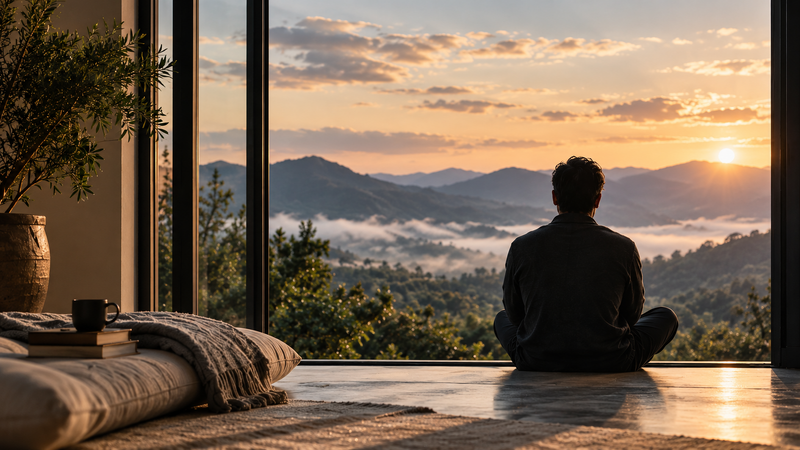
There’s an understandable movement happening in a lot of personal growth and spiritual circles.
People are tired of the relentless pressure to do more, achieve more, earn more, optimize more. Many have spent years pursuing the next goal with the implicit promise that somewhere on the other side of it, they’ll finally feel different.
More successful. More secure. More worthy. More free.
At some point, we begin to see through that promise.
More money doesn’t necessarily create security. Achievement doesn’t necessarily create worth. Being chosen by someone else doesn’t guarantee that we feel loved. We can spend years rearranging the circumstances of our lives while the internal experience we were hoping those circumstances would create remains strangely elusive.
So we look in another direction.
We slow down. We simplify. Maybe we meditate or spend more time in nature. We question how much we really need. We become suspicious of hustle, consumption, status, and perhaps even ambition itself.
There’s wisdom in that correction.
We often don’t need nearly as much from the external world as we once imagined. Creating space can also show us just how much noise we’ve been carrying.
But there’s another question that comes after that realization:
What if we’ve confused a change in conditions with greater freedom?
Feeling different when we change our environment tells us something important. But it doesn’t necessarily tell us what we think it does.
If I leave a stressful environment and feel peaceful, perhaps I’ve discovered that the environment was genuinely unhealthy for me.
Or perhaps I’ve discovered that peace is much easier for me to access under certain conditions.
Those aren’t the same discovery.
When preferences become virtues
One of the blind spots I see in some psychospiritual culture is how easily preferences can become virtues.
Simplicity begins to look more conscious than abundance. Slowness looks more authentic than ambition. Nature feels more real than modern life. Wanting less can start to look more evolved than wanting more.
None of those conclusions necessarily follow.
A quiet life in nature can be deeply aligned for one person and deeply avoidant for another. Someone can lose interest in achievement because they genuinely no longer need it to prove anything. Someone else can lose interest in achievement because achievement still has enough emotional charge that avoiding the whole game feels safer.
From the outside, those may look exactly the same.
Lifestyle is visible.
We can see that someone left the corporate world. We can see the small house, the reduced schedule, the meditation practice, the move somewhere quieter. Those choices can become outward evidence of an inward story:
I’m no longer caught in all of that.
Internal freedom is harder to see.
You can own very little and be deeply attached to owning very little. You can organize your life around peace and gradually become less able to maintain your center anywhere that isn’t peaceful.
Sometimes what looks like freedom is actually a smaller range of conditions under which we know how to be okay.
A more useful question is:
Is this condition supporting a capacity, or substituting for one?

In the inner training practices I’ve developed and now teach in my coaching, we deliberately train access to emotional states rather than waiting for circumstances to create them for us.
We create conditions that help us access a state. We become familiar with it. We strengthen our capacity to return to it.
The conditions are useful.
But they aren’t the point.
Nature can make presence easier. Quiet can make peace easier. A slower pace can help a taxed body settle. There are times when changing our environment is exactly the right thing to do.
The question is what happens when the environment changes again.
If I can access peace only when life is quiet, how much peace have I actually trained?
If I feel free only when I have very few responsibilities, what happens to that freedom when I choose to carry something meaningful?
If I need to remove every activating condition from my life in order to remain centered, I may feel much better. And sometimes removing those conditions is wise.
But feeling better and developing greater internal range are not always the same thing.
When dependency changes sides
We can recognize the problem with achievement and recreate the same problem in reverse.
If I spend years believing success will finally make me feel worthy, I’ve given success an emotional job.
If I believe money will finally make me feel secure, I’ve given money an emotional job.
Inner work can help us see that.
But recognizing the dependency doesn’t guarantee that we’ve released it. We can simply move it.
We can stop depending on achievement and start depending on the absence of achievement.
Instead of needing success to create peace, we begin needing simplicity to preserve it.
The story changes from:
I’ll be okay when I achieve enough.
to:
I’ll be okay as long as I don’t have to participate in that world.
The dependency changes sides.
But it may still be dependency.
If money had been carrying security for me, deciding money doesn’t matter doesn’t automatically train security. If achievement had been carrying worth, deciding ambition is ego doesn’t automatically train worth.
And if the only way I know how to experience peace is by arranging my life so that very little disturbs it, I haven’t necessarily transcended my dependence on circumstances.
I may simply have become much better at selecting them.

This is why the measure I keep coming back to is range.
Can the state I’ve been cultivating travel with me into more of my life?
Can some of the peace I find in quiet remain available when life gets busy?
If I experience enoughness while living simply, what happens in the presence of abundance?
If I feel grounded on retreat, how much of that groundedness comes home with me?
This isn’t about deliberately putting ourselves in unhealthy situations. And it isn’t about becoming unaffected by circumstances.
Conditions affect us. They should.
The point is to expand the range of conditions under which we still have access to ourselves.
Decades of martial arts practice have made this distinction very concrete for me. A skill often becomes available first under controlled conditions. We slow things down. Remove variables. Create enough structure for the skill to develop.
There’s nothing false about that.
But eventually the conditions change.
There’s more pressure. More speed. More uncertainty.
The question becomes whether the capacity developed in practice can travel.
Inner training works much the same way.
The quiet room matters.
And then eventually we leave the room.
Being and becoming
None of this makes the outer world irrelevant.
Training security doesn’t mean financial reality stops mattering. Training love doesn’t make an unloving relationship loving. Training peace doesn’t make an unhealthy environment healthy.
Inner capacity should help us see external reality more clearly, not teach us to ignore it.
Money gives us real options. Relationships can nourish us or harm us. Our bodies have limits. Our environments affect us.
Inner training isn’t about becoming so self-contained that we no longer need anything or anyone.
It changes the job we assign to those things.
I can deeply value a relationship without making another person responsible for whether I experience myself as lovable. I can appreciate the freedom money provides without waiting for a particular number before I allow myself to experience freedom.
And I can genuinely love a quiet, simple life without needing to turn that preference into a philosophy about how everyone should live.
We don’t have to choose between being and becoming.
I can experience enoughness and still want more.
I can love my life and still change it.
I can enjoy simplicity without making simplicity a virtue.
And I can build something difficult without believing its success will finally complete me.
That feels like a much more interesting freedom.
Not constructing a life in which nothing activates me, but developing enough internal range that I can participate more fully in the life I actually want.
Not asking whether I should want more or want less.
But asking:
How much of my inner life am I asking the outside world to create for me?
Because inner training isn’t about wanting less.
It’s about needing less from what you want.
And when I need less from what I want, I don’t have to reject it.
I’m freer to pursue it. Freer to enjoy it. Freer to discover that I no longer want it.
And freer to remain connected to myself either way.
I can be here now.
And I can still create what comes next.