
Why “Every Day” Is Easier Than “Sometimes”

Have you ever noticed that doing something every day can actually feel easier than doing it sometimes?
That sounds strange at first. Because every day sounds more intense.
Run every day. Write every day. Practice every day. Go to the gym every day.
It sounds like more pressure.
But a lot of the time, the hardest part is not doing the thing.
It’s the little argument about whether you really have to do it today.
Because once the rule is, “I’ll do it when I can,” or, “I’ll do it a few times a week,” or, “I’ll get back to it soon,” now every day has a question built into it.
“Is today the day?” “Can I move it to tomorrow?” “Do I feel like it?” “Have I done enough already?”
And before you’ve even started, you’re already in a conversation with the part of you that wants the easier option.
The action itself might be pretty simple. The run might take twenty minutes. The gym session might be short. The writing might only be one page.
Cleaning the kitchen might take less time than thinking about how annoying it is that the kitchen is still messy.
But the argument can spread across the whole day.
You think about it in the morning. Then you push it off. Then you think about it again at lunch. Then you tell yourself you’ll do it after work.
Then after work, you’re tired. So now there’s a new conversation.
And by the time you finally skip it, it almost feels like relief.
But not exactly.
Because underneath the relief, there’s often this small residue.
Some part of you knows the thing itself probably would have been easier than the whole negotiation around the thing.
And this is where “every day” starts to make more sense.
Not because every day is easy. It’s not.
And not because everyone should do everything every day. That would be ridiculous.
But there’s something powerful about a clear rule.
A clear rule removes the daily argument.
That’s the part that matters.
Not the intensity of the rule. Not how impressive it sounds. Not whether someone else would respect it.
Just the fact that the rule is clear enough that you no longer have to reopen the decision every time your mood changes.
And the rule has to be yours.
Not the internet’s rule. Not the version that looks good in a video. Not what some highly disciplined person says everyone should do.
Your rule.
Because the rule only works if you can actually keep it.
Maybe your rule is running two miles a day. Maybe it’s walking for ten minutes. Maybe it’s writing one paragraph.
Maybe it’s practicing piano before dinner. Maybe it’s going to the gym, even if some days are lighter than others. Maybe it’s cleaning the kitchen before you go to bed.
The point is not the size of the rule.
The point is that the rule removes the argument.
Because without a rule, the mind has room to keep reopening the case.
“Do I feel like it?” “Is today really necessary?” “Can I push it to tomorrow?” “Maybe I should just restart Monday.”
And the mind can be very convincing.
Especially when you are tired. Or bored. Or irritated. Or already comfortable on the couch.
That’s why the timing of the question matters.
A lot of people ask themselves whether they should follow through at the exact moment when their answer is going to be least reliable.
You ask whether you should run when your body feels heavy.
You ask whether you should go to the gym when you’re already home, shoes off, dinner almost ready.
You ask whether you should write after you’ve already opened YouTube.
Of course the answer gets blurry there. Of course the mind starts building a case.
“I should listen to my body.” “I don’t want to be too rigid.” “I’ve had a long day.” “I’ll reset tomorrow.”
And sometimes those things are true.
Sometimes rest is intelligent. Sometimes changing the plan is wise. Sometimes the body really does need a different kind of care.
But we also know there is a version of that conversation that is not wisdom.
It just sounds like wisdom.
There is a version of “I should rest” that is actually avoidance.
There is a version of “I’ll do it tomorrow” that is really just trying to get through the discomfort of today.
There is a version of “I don’t want to be rigid” that is really fear of being accountable to a clear choice.
And I think most people can feel the difference.
Maybe not right away.
But if you get quiet for a second, you can usually tell.
There’s a clean adjustment. And then there’s negotiation.
Clean adjustment feels simple.
“I’m exhausted today. I’m going to walk for ten minutes instead of run.”
“I’m sore. I’ll go to the gym and do something lighter.”
“I don’t have the energy to write for an hour. I’ll write one paragraph.”
That has clarity in it.
But negotiation has a different feeling.
It circles. It argues. It keeps searching for the reason that finally lets you off the hook.
And the strange thing is, negotiation can feel exhausting even when you technically win.
You get out of the thing. You don’t have to do it.
But you don’t feel stronger after it. You don’t feel more free.
You just feel like the part of you that wanted the easier option won again.
And I don’t mean that in a shameful way.
This is not about beating yourself up.
It’s more like noticing the mechanics of what happens.
Every time the decision gets reopened, your current state gets to vote.
That’s the deeper piece.
When you are clear, rested, and connected to what matters, your vote may be very different.
You might say, “Yes, I’m going to train today.” “Yes, I’m going to write.” “Yes, I’m going to practice.”
But when the moment comes, you may not be in that same state.
You might be tired. You might be irritated. You might be bored.
And now that state gets a vote too.
It gets to ask, “Do we really need to do this?”
And if there is no clear rule, that state can become very persuasive.
That’s why the rule matters.
A clear rule is not just a schedule.
It’s a way of protecting your clearer choice from being renegotiated by a temporary state.
That’s a very different way to think about consistency.
Because most people think consistency is about having more discipline. More willpower. More motivation. More intensity.
But sometimes consistency gets easier when there is simply less to decide.
Less debate. Less inner bargaining.
Less waking up every day and asking, “Who am I going to be today?”
Every time the decision is open, identity is open too.
Am I the person who follows through today? Am I the person who pushes it off today? Am I the person who keeps the agreement? Am I the person who finds a loophole?
That is a lot to decide over and over again.
A clear rule simplifies it.
You already decided.
Now the question is not, “Do I do it?”
The question is, “What does it look like today?”
That question has more steadiness in it.
It allows room for real life.
Maybe today’s run is slow. Maybe the gym session is lighter. Maybe the writing is not very good.
But the rule stays alive.
The thread stays alive.
You don’t break the relationship with the thing that matters.
And there is something calming about that.
Because now the practice is no longer dependent on whether you feel inspired.
It’s no longer dependent on having the perfect day.
It’s no longer dependent on your mood being fully on board.
You are learning to move before the state agrees.
That is a big shift.
Because most people are waiting for the right feeling to create the action.
They’re waiting to feel motivated. Waiting to feel focused. Waiting to feel ready.
And sometimes that feeling comes.
But a lot of the time, it doesn’t come first.
It comes after you start.
You put on the shoes. Then the body begins to wake up.
You drive to the gym. Then the resistance starts to quiet down.
You sit at the desk. Then a sentence comes.
You clean one plate. Then the rest of the kitchen feels less impossible.
The state often changes after the first repetition.
But if you wait for the state before you begin, you may never get to that moment.
That’s why the rule is so useful.
The rule carries you through the beginning.
And beginning is often where the most resistance lives.
Once you’re moving, the thing itself is usually more manageable than the story around it.
The first step out the door is often harder than the run.
Changing clothes is often harder than the workout.
Opening the document is often harder than writing the first sentence.
Starting the task is often harder than the task.
Because before you start, the mind can imagine everything.
How long it will take. How annoying it will feel. How tired you are. How much you don’t want to.
But once you’re in motion, the imagination has less room.
Now you’re just doing it.
One step. One rep. One sentence. One dish.
One small action that proves you are not trapped inside the debate.
And this is why the minimum matters.
A lot of people miss this.
They hear “every day” and imagine some extreme standard.
Run five miles every day. Write for three hours every day. Train hard every day. Never miss. Never adjust. Never be human.
But a good daily rule usually has a floor.
A minimum that keeps the practice alive without requiring perfection.
Two miles. Ten minutes. One page. One song. One short walk. One set.
Something small enough that you can do it even on a less-than-ideal day.
Because the purpose of the minimum is not to impress anyone.
The purpose is to remove the loophole.
It gives you a way to say, “I may not do the big version today, but I’m still keeping the relationship with the practice.”
That’s very different than all-or-nothing thinking.
All-or-nothing thinking says, “If I can’t do the full workout, why bother?”
“If I can’t write something great, why start?”
A minimum says, “No, we’re not doing that.”
“We’re going to keep the thread.”
That phrase matters.
Keep the thread.
Because when you keep the thread, you don’t have to restart your identity every few weeks.
You don’t have to go through that whole cycle of falling off, feeling frustrated, making a dramatic new plan, pushing hard for a few days, then falling off again.
You just return.
Daily. Quietly. Maybe imperfectly.
But you return.
And over time, that returning becomes part of who you are.
Not in a loud way. Not in a “look at how disciplined I am” way.
More like your system starts to understand, “This is what we do.”
And once that happens, the practice does not take as much emotional convincing.
It becomes normal.
You don’t have to feel inspired by it every day.
You just notice, “I did it again.”
And after a while, “I did it again” becomes, “Of course I did.”
That kind of confidence is different.
It’s not hype. It’s not a mood. It’s not based on telling yourself you’re amazing.
It comes from repetition.
It comes from evidence.
It comes from watching yourself follow through when part of you didn’t feel like it.
Because when you do the thing every day, you are not only training the behavior.
You are training your relationship with resistance.
You are training your relationship with discomfort.
You are training your relationship with your own word.
You’re learning, “I can feel resistance and still move.”
“I can feel tired and still do the smaller version.”
“I can feel uninspired and still begin.”
“I can feel the argument starting and not hand it the steering wheel.”
That’s where the deeper change happens.
Because the old pattern is not always that you don’t know what to do.
A lot of the time, you know.
You know you feel better when you move your body. You know you feel clearer when you write. You know practice matters if you want to get good.
You know the basics.
The question is whether the knowing becomes action when the mood is not helping you.
That’s where the training is.
Not in the moment when everything feels clear and easy.
In the moment when the old argument shows up and says, “Maybe not today.”
And this is where people sometimes misunderstand consistency.
They think consistency means you become this perfectly disciplined person who never feels the pull to skip.
I don’t think that’s true.
The pull may still come.
The difference is that you stop treating the pull as the decision.
You can notice it. You can even understand it.
“I’m tired.” “I’m bored.” “I don’t want to.” “This feels annoying.”
But those are experiences.
They are not instructions.
That distinction matters.
Because if every uncomfortable feeling becomes an instruction, your life gets very small.
You only move when your state gives permission.
You only follow through when resistance is absent.
You only become consistent when consistency feels convenient.
And that is a hard way to build anything meaningful.
Anything meaningful will eventually ask you to act when the mood is not there.
The relationship. The business. The health. The craft. The body. The home.
The thing you keep saying matters.
At some point, it will ask for a repetition on a day when you would rather skip.
And if the decision is still open every time, that day becomes a battleground.
But if the rule is clear, the whole thing gets simpler.
Not easy.
Simpler.
Less mental noise. Less negotiation. Less wondering who you are today.
You already chose.
Now you just find the version that fits the day.
That is also why the rule has to stay connected to the person you are becoming.
Without that, a rule can turn rigid. It can become ego. It can become streak maintenance. It can become fear of missing.
And then the rule stops creating steadiness.
It creates pressure.
So the rule needs to be clear, but it also needs to be alive.
It needs to serve something real.
Not just, “I have to do this because I said so.”
More like, “This is the way I keep returning to what matters.”
That’s a different feeling.
One is harsh. The other is steady.
One is pressure. The other is practice.
And when the rule is connected to something that matters, it becomes less about forcing yourself and more about remembering.
Remembering what you chose.
Remembering who you’re becoming.
Remembering that the mood of the moment is not the whole truth.
That’s why every day can be easier than sometimes.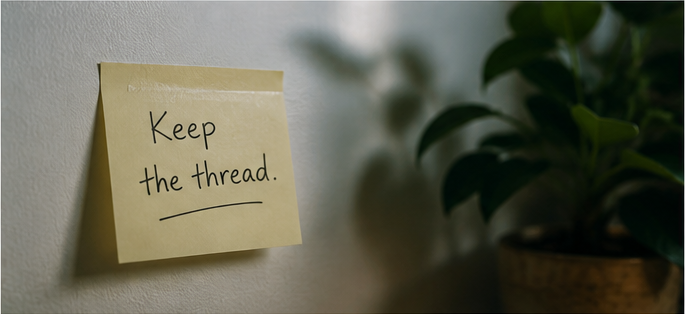
Not because every day requires less effort.
Because every day can require less negotiation.
And for a lot of people, negotiation is what has been quietly draining them.
Not the run. Not the gym. Not the writing. Not the practice.
The debate.
The reopening.
The daily question of, “Do I really have to?”
And maybe the answer does not need to be dramatic.
Maybe the answer is just, “Yes. In some form, yes.”
Yes, I’m going to keep the thread.
Yes, I’m going to do the small version.
Yes, I’m going to honor what I chose when I was clear.
Yes, even if the mood is not fully on board yet.
And after enough repetitions, that yes starts to become familiar.
It starts to become part of your baseline.
Not perfect. Not rigid. Not impressive to anyone else.
Just steady.
And maybe that is what people are actually looking for when they talk about discipline.
Not more pressure.
Not more self-control in some harsh way.
But less inner argument.
Less starting over.
Less wondering whether they can trust themselves.
A simpler relationship with the things they say matter.
And that begins with a clear rule.
A small enough rule.
A rule you can actually live.
And then the willingness to stop asking the version of you that does not want to do it whether today is the day.
Because that version will almost always have an argument.
The practice is learning not to build your life around that argument.