
You’re Not Reacting to What Happened. You’re Reacting to What It Meant.
A lot of people think the event causes the reaction.
They didn’t text back, so I got anxious.
They got quiet, so I shut down.
They criticized me, so I defended myself.
And on the surface, that sounds true. Something happened. Then you reacted.
But when you slow it down, there is usually one more step in the middle.
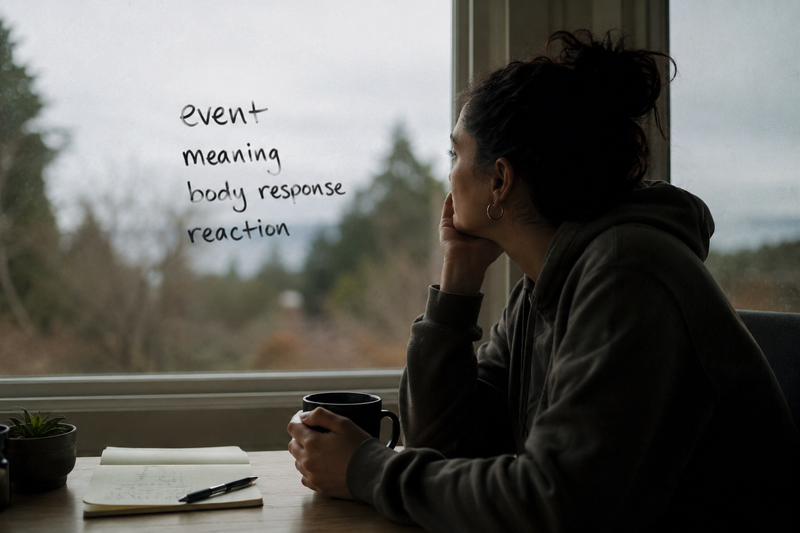
The event happens. The moment lands a certain way inside you. Your body responds as if that meaning is true.
And then the reaction starts.
That’s cause and reaction.
Not just what happened and what you did.
What happened.
What it meant.
And what happened next.
That’s the part most people miss.
They think they are reacting to what happened. But a lot of the time, they are reacting to what it seemed to mean.
Someone takes longer than usual to text you back. One day, you barely react. You think, “They’re probably busy.”
Another day, that same delay feels personal. Now you’re checking your phone. Now you’re rereading what you sent. Now you’re wondering if you said too much.
Same event. Different reaction.
So something else is involved.
Someone gets quiet in a conversation. That’s the event.
But the moment might land as, “They’re upset with me.”
Or, “They’re pulling away.”
Or, “I did something wrong.”
And once that meaning lands, the reaction starts.
You explain more than you need to. You start managing their mood. You get careful.
You stop saying what you actually wanted to say.
And later, you may not even remember the exact sentence that triggered you. You just remember how quickly you stopped feeling like yourself.
Or maybe you go the other direction.
You get sharp. You act like you don’t care. You pull back first, so you don’t have to feel them pulling back from you.
And from the outside, it looks like you’re reacting to their silence.
But you’re not only reacting to their silence.
You’re reacting to what their silence meant inside you.
That’s a very different thing.
Because if you don’t see the meaning, you’ll try to control the event.
You’ll need them to respond faster. You’ll need them to use the right tone. You’ll need the conversation to stay calm.
You’ll need the outside world to give you the exact evidence your body is looking for so you can feel okay.
And of course, sometimes those things matter.
Tone matters. Timing matters. The actual words matter.
Sometimes your read is right. Someone may be pulling away. The tone may be sharp. Something may need to be addressed.
But you still want to know whether you’re responding to the moment in front of you… or to every older moment that feels similar.
That’s an important distinction.
Because you can be right about what happened and still be reactive in how you respond.
Someone may have used a sharp tone. They may have been distant. They may have misunderstood you.
But if the meaning underneath is, “I’m not safe,”
or, “I don’t matter,”
or, “I’m about to be rejected,”
your response may come from protection instead of clarity.
And that protection might make sense. It may have a history. It may have helped you at some point.
But it may not help you create what you actually want now.
The point is not to distrust yourself.
The point is to slow down enough to know what you’re actually responding to.
Because if your state depends on the outside world giving you the exact evidence you need, you’re going to feel unstable.
People will be distracted. They’ll be tired. They’ll say things imperfectly. They’ll take longer to respond.
They’ll have moods that are not about you.
And if every one of those moments gets translated through a familiar meaning, you’re going to keep having reactions that feel bigger than the situation.
That’s usually the clue.
The reaction feels bigger than the moment.
The delay was small. But the anxiety was not small.
The comment was small. But the defensiveness was not small.
The look on their face was small. But the story your mind built around it was not small.
Because sometimes the moment is small… but it touches something that is not small.
Your chest tightens. Your jaw sets. Your stomach drops.
And before you’ve really chosen anything, you’re already preparing a response.
That’s where you pause.
Not to shame yourself.
Not to talk yourself out of what you feel.
Just to ask, “What am I making this mean?”
That question is simple. But it cuts through a lot.
They didn’t text back.
What am I making that mean?
My partner got quiet.
What am I making that mean?
The conversation felt tense.
What am I making that mean?
The tone shifted.
What am I making that mean?
And sometimes the answer is not very flattering.
“I’m making it mean I’m not important.”
“I’m making it mean they don’t care.”
“I’m making it mean I did something wrong.”
“I’m making it mean I’m not safe here.”
But the moment you can name the meaning, you are no longer completely inside it.
You can see it.
And that little bit of space matters.
Because now you can ask a second question.
“Is that actually what this means?”
Not in a fake-positive way.
Not, “Everything is fine.”
Just honestly.
Is that what this means?
Or is this the meaning I learned a long time ago?
Is this what is happening right now?
Or is this what this moment reminds me of?
That distinction changes things.
Because a delayed text is not always rejection.
A quiet partner is not always disconnection.
A hard conversation is not always danger.
A sharp tone is not always proof that you did something wrong.
But if the body has learned those meanings, it will react as if they are true.
And then the reaction often creates the next problem.
You feel unimportant, so you send the sharp text. Now they get defensive. Now they pull back.
And now your mind says, “See? I knew they were pulling away.”
Or you feel criticized, so you defend. Now the other person feels unheard. Now the conversation gets harder.
And now your mind says, “See? We can’t communicate.”
That is how the loop gets reinforced.
The moment touches a conclusion that already feels familiar.
The meaning creates a reaction.
The reaction creates more evidence.
And the evidence seems to prove the original meaning.
Once you can see that chain, the reaction becomes less mysterious.
You stop saying, “Why am I like this?”
And you start seeing, “Oh. That’s the sentence that pulled me in.”
That’s where the reaction starts.
You train this in the small moments.
The next time someone gets quiet.
The next time the response takes longer than you wanted.
The next time the tone shifts.
The next time you feel the old reaction start to rise.
You slow down enough to ask, “What did I just make this mean?”
So just take one moment with this.
Think of one recent moment where your reaction felt bigger than the situation.
Not a huge moment.
Just something simple.
A text. A tone. A look. A conversation that stayed with you longer than you expected.
And just ask yourself, “What did I make that mean?”
Not to judge it.
Not to fix it.
Just to see it.
Because the moment you can see the meaning, you are no longer completely inside the reaction.
Sometimes that one question will not change the whole reaction.
But it may change your relationship to it.
And sometimes that’s enough.
Not to make the reaction disappear.
But to stop obeying it so quickly.
That is often where the first real choice shows up.